** Article published in Argentinian version of El Tiempo.
Originally published at: http://www.telesurtv.net/bloggers/Balotaje-en-clave-continental-20151029-0004.html
By Juan Manuel Karg
29 October 2015
The upcoming 22nd of November. Argentina will go to the a second round of elections for the first time in the history of the country, faced with two antagonistic political models; that expressed by the Front For Victory (Frente Para la Victoria), presently in government, and that headed by the conservative coalition, PRO+UCR1, that looks to retake political power in the country after twelve years of Kirchnerist governments.
What is the regional importance that these elections have? Why are the Latin American right-wing huddled waiting for a hypothetical triumph of Macri? The novelty of the closeness between Daniel Scioli (FPV) and Maurico Macri (PRO), expressed at the ballot box the past 25th of October, has already passed, it necessary to realise that the insertion of the second round in Argentina is the framework of a regional debate.
To contextualise: after the decisive elections in Argentina two important electoral dates in Latin America will take place. The 6th of December Venezuela should renew its National Assembly, in a growing contest between the pro-government PSUV2 and the conservative alliance MUD3; and the 21st of February of the coming year Bolivia will got to the ballot box to define if will allow Evo Morales Ayma to stand again for a new presidential period.
Therefore Henrique Capriles took a stance, scarcely knowing the news of the second round in Argentina, saying that “the big challenge that Mauricio Macri has if he wants to win the election is to be the leader of change”. What is Capriles after? That a hypothetical triumph of Mauricio Macri might strengthen the Venezuela right, to look to the 6th of December to overcome Chavismo4 at the ballot box, something that hasn't happened ever – with the exception of the 2007 referendum – since Chávez arrive to Miraflores5 in 1999.
In similar manner the Bolivia cement business owner, Samuel Doria Medina – also an ex-presidential candidate –did the same by saluting “the unity lead by Macri, unity that will be a victory 22-N”, in order to later annouce that “a new time arrives”. What is the intention of Doria Medina? That a hypothetical triumph of Macri might strengthen the “NO” a possible renomination of Evo Morales. You also have to highlight the link of Ecuatorian banker and leader of the opposition to Rafael Correa, Guillermo Lasso, who said that “the struggle of Mauricio Macri inspires us and fills us with energy to reach better days in Ecuador”.
Verifying an advance of the right in Argentina could have direct repercussions not only in the elections of Venezuela and Bolivia, but also in the institutional framework that the region has constructed during these years. An example: Will Mercosur6 will in a “flexibilisation” - such as Aécio Neves in Brazil and Luis Alberto Lacalle Pou in Uruguay were demanding in their respective campaigns in 2014 – so that the member countries can sign FTA in a direct way with, for example, the European Union? Judging by the document presented last April by the “Consensus Group” - space of encounter of the guides of international politics of the PRO and of radicalism -, yes, asking “to strengthen our relations with Europe and the United States” and advancing in a “fast, broad and frank discussion with our partners in Mercosur”, looking for an opening towards the Pacific Alliance7.
It isn't hare-brained, then, with these important elements, to consider that the second round in Argentina will have a significance that surpasses, by far, the borders of the country. It puts in play, such as happened in the elections in Venezuela in 2013 and in Brazil in 2014, one of the most important governments of the post-neoliberal administrations in the regions, that precisely said NO to ALCA8, ten years ago.
Will there be a “conservative restoration” or will the Argentinian people confront this option, as they have been doing in the last regional elections? Judging by these direct precedent – no government from the “change de epochs” being defeated in elections – one can be an optimist.
1PRO - Republican Proposal (Spanish: Propuesta Republicana, PRO) is a center-right political party in Argentina.
UCR - The Radical Civic Union (Spanish: Unión Cívica Radical, UCR) is a social-liberal political party in Argentina. The party has been ideologically heterogenous, ranging from classical liberalism to social democracy.
2United Socialist Party of Venezuela, the main party of government supporting the revolutionary process
3Mesa de la Unidad Democrática (Democratic Unity Roundtable; MUD), the electoral coalition of right-wing Venezuelan opposition parties.
4Political movement supportive of and following the policies and politics of Hugo Chávez
5The official workplace of the President of Venezuela, the presidential palace.
6Spanish: Mercado Común del Sur; is a sub-regional bloc. Its full members are Argentina, Bolivia, Brazil, Paraguay, Uruguay and Venezuela. Its purpose is to promote free trade and the fluid movement of goods, people, and currency. It is now a full customs union and a trading bloc.
7The Pacific Alliance (Spanish: Alianza del Pacífico) is a Latin American trade bloc, with some features of further integration. It currently has four member states—Chile, Colombia, Mexico, and Peru, which all border the Pacific Ocean.
8The Free Trade Area of the Americas (FTAA) (Spanish: Área de Libre Comercio de las Américas) was a proposed agreement to eliminate or reduce the trade barriers among all countries in the Americas, excluding Cuba.
Showing posts with label Latin America politics. Show all posts
Showing posts with label Latin America politics. Show all posts
Thursday, 19 November 2015

Wednesday, 28 October 2015
Contributions to Understand the Argentinian Labyrinth (translation)
By Alfredo Serrano Mancilla
Originally published at ALAI AMLATINA, http://www.alainet.org/es/articulo/173228
26/10/2015.
With this panorama, what one can affirm is that up until this moment there still isn't a President. The first round only served to open the debate for the second round. In Argentina, one only wins in the first round if it happens that: 1) you get more than 45% of the votes, or 2) you get more than 40% and you have a difference of 10 points with respect to the second highest tally. Neither of these two situations has taken place. The country already thinks about a second round, the first time in history, on the 22th of November: the contest will be between the pro-government candidate Scioli and the conservative Macri.
3. Scioli carries the weight of an administration of eight years in the Province of Buenos Aires (36% of the electoral roll), with his good decisions, but also with his mistakes. He has a presidential profile, but very distance to the epic, to the emotivity, of the Kirchnerist narrative. Scioli didn't manage to identify himself with the youthful impression that has so much characterised Kirchnerism in recent years. He is too much from the 20th century, perhaps, for 21st century politics. His discourse is surely typical of a more obsolete Peronism than that which Kirchnerism has been moulding. Besides, Scioli opted for scarcely confronting: he preferred to talk like he had already won. He accepted easily in this way the field proposed by Macri's advisers (especially of Durán Barba) of avoiding to dirtying himself in the boxing ring. And in politics, in the democratic electoral game, to win, you have to enter the arena, and fight, giving and receiving, with respect, but also cornering to the rival questioning him on every proposal. Surely, it will be like that the Scioli that we will see from now until the end of the campaign of this second round. Better late than never.
4. The Argentinian right has known to reinvent itself. That which appears to be an isolated attempt with Macri as the leader in the capital, has today converted into a movement with a presence in all the territory. Macrism went from a little: to covering the length and breadth of the country. Bringing together in the first stage characters know to be remote from traditional politics. But later, in the second moment, it commenced to weave alliances with old political parties (particularly with radicalism) to provide itself with territorial structure. Macri has been using a very 21st century language, with the new tone of the right on good terms. Constantly avoiding confrontation; distancing itself from its own past of neoliberal appearance; knowing to carry out everything advanced by the political opponent. It has scarcely proposed anything new despite having wanted to present itself as the leader of change. Its programmatic emptiness was packed with political marketing. This is the new strategy of the regional right that obeys good sportsmanship and resignation that the new common sense is characteristic of a change of epics in Argentina and in a good part of Latin America. In this way Macri has managed to slip through to a second round with real options of winning. This election it has tallied up; it leaves with the wind in its favour. But its real capacity of victory will depend a great deal on how it finds itself in a ring against Scioli. Up until this moment, a scenario not desired either by one or the other. We will see what happens from now on.
5. The mediator, Massa, managed to remain inside despite the duel of the two. Massa, the past of Kirchnerism, and now more anti-Kirchnerist than Macri, knew to negotiate what is supposed to be the importance of the votes useful in this type of electoral situation. He snuck into the party to stay. His discourse had a pendular movement: from conservative right in everything referring to punishment against insecurity, and liberal in everything economic. He was more critical of the role of the State than Macri. He looked to the extreme for confrontation, which served to express with notoriety his political proposal. No doubt that getting 21% of the vote permits him to constitute himself as the key to the second round. In his speech last night, he put his price: he sold himself to the highest bidder. Although everything appears to indicate that he will end up as an ally of Macri, one mustn't either rule out that he might offer himself to Scioli (he is anti-Kirchnerism, but it isn't so clear whether he might be anti-Scioli); or maybe he might not decide for either of the two in an explicit way thinking from here more on what could happen in four years.
6. Finally, it is always a key that brings with it the maximum difficulty at the time of explaining what happened in a electoral contest: it is that which we call the people. In Argentina, in these years, the social majority isn't by any means that which left from the crisis, from the playpen, from hungry and from misery. The change is change in all is fullness. And meanwhile what society thinks, demands, imagines, and votes for transforms. What a decade ago was a social demand, today (fortunately) is a naturalised right. The people want more; they have new questions, and it requires new responses. The popular and plebian can't at all be conceived as a static category. This is without doubt one of the fundamental axes of these future years in dispute, between the attempt of conservative restoration and the process of change that is in march.
These are some lines to understand what happened in this new map of Argentinian electoral politics after the elections. There isn't else left to do, but await the following electoral date to know who will be President from the 10th of December this year. From now, starts another campaign that had nothing to do with the previous one. Surely, the final outcome will depend more the Kirchnerist strategy than on what Macri can do. What Kirchnerism proposes and what Scioli decides to do will be the keys to what comes. But that is already another story.
- Alfredo Serrano Mancilla is the Director of the Strategic Centre of Latin American Geopolitics (CELAG).
[1] YPF, the initials of Yacimientos Petrolíferos Fiscales ; English: "Fiscal Oilfields ", is a vertically integrated Argentine energy company, engaged in the exploration and production of oil and gas, and the transportation, refining, and marketing of gas and petroleum products
[2] La Cámpora is an Argentine political youth organization supporting the governments of Néstor Kirchner and Cristina Fernández de Kirchner. It is named after former Peronist president Héctor José Cámpora.
Originally published at ALAI AMLATINA, http://www.alainet.org/es/articulo/173228
26/10/2015.
Everything that habitually happens in
Argentina after an electoral date has
commenced. The battle of the day after started even before the electoral day
itself had ended. Everyone proclaimed themselves the winners. Sergio Massa
(Unidos por una Nueva Argentina [United for a New Argentina]), that achieved
third place, assumed himself the winner because it was the first time he stood
in a presidential election and he obtained a good result, 21.34%. Second placer
getter, Mauricio Macri (Frente Cambiemos [We Change Front]), with 34.33%, sees
himself with possibilities to be first. And the first place getter, Daniel
Scioli (Frente para la Victoria [Front for Victoria]), with 36.85%, forcibly
happy, because in the end there
wasn't any other option but to celebrate being the person who got the most
votes despite being far from what was desired.
With this panorama, what one can affirm is that up until this moment there still isn't a President. The first round only served to open the debate for the second round. In Argentina, one only wins in the first round if it happens that: 1) you get more than 45% of the votes, or 2) you get more than 40% and you have a difference of 10 points with respect to the second highest tally. Neither of these two situations has taken place. The country already thinks about a second round, the first time in history, on the 22th of November: the contest will be between the pro-government candidate Scioli and the conservative Macri.
The majority of the polls showed again
their incapacity to ascertain the electoral preferences in a country where
society has changed drastically in a few years. There hasn't been any poll that
has dared to predict a margin so narrow between both alternatives after that a
few months ago, in August, in the Obligatory and Simultaneous Open Primaries
(PASO), Scioli obtained 38.67% facing the 30.12% of Macri. What happened
between the PASO and what happened in this electoral conflict? What has
occurred with these more than 8 points of difference that has now converted
itself into only 2? What happened to the 54% that the President Cristina Fernández
de Kirchner (CFK) obtained in the previous presidential elections of 2011?
Some reasons to respond to these questions are the following:
1. The principal thing, undoubtedly, it that Scioli wasn't the best candidate of the Kirchnerist projects. During these months officialism tried to set up the idea that “the candidate is the project” as a formula, to combine the figure of Scioli with what Kirchnerism has been doing. All the evaluations of Kirchner policies and of the President were looking very positive (above 50%) in the recent months. It was so much like this that the the electoral tactic of the opposition wasn't characterised by confrontation. The campaign didn't focus on the nationalisation of YPF[1], or Aerolíneas Argentinas, nor the triumphant restructuring of foreign debt, nor on the public policies guaranteeing social rights. Scioli tried to capitalise on all of it, but he didn't manage to do it. He tried to be the candidate of the project, but he didn't achieve it. There was too much difference between the candidate and the project. Scioli isn't written with a K.
2. CFK didn't want to (or couldn't) be the determinant throughout the campaign. The President withdrew even since before it was established that Scioli was going to be the candidate. She scarcely participated in the campaign. She didn't managed build up a candidate more tailored to her either, more allied to the centre of Kirchnerism. She didn't have that fight; or she had it, but lost; or she believed that she didn't have a winning candidate in her ranks; or she trusted in herself believing that she could think about the next presidential contest without having won still this one. This “distance” of CFK from the elections has had a high cost. The figure of the Vice-President, imposed by the President, Zanini, appeared, at moments, to be a candidate from another party. More an ally than a running mate. The Kirchnerist proposal for the Province of Buenos Aires, Aníbal Fernández, wasn't correct in light of the results: he lost a Peronist bastion at the hands of the Macrista María Eugenia Vidal. In short, you can affirm that the President didn't add up to what was expected. It was so much so that for example her most symbolic and important organisation in these years, the Cámpora[2], didn't even attend the closing of Scioli's campaign. In politics, every detail counts. And this “attitude of distance”of CFK from Scioli has undermined and surely erroded more than what was predicted.
Some reasons to respond to these questions are the following:
1. The principal thing, undoubtedly, it that Scioli wasn't the best candidate of the Kirchnerist projects. During these months officialism tried to set up the idea that “the candidate is the project” as a formula, to combine the figure of Scioli with what Kirchnerism has been doing. All the evaluations of Kirchner policies and of the President were looking very positive (above 50%) in the recent months. It was so much like this that the the electoral tactic of the opposition wasn't characterised by confrontation. The campaign didn't focus on the nationalisation of YPF[1], or Aerolíneas Argentinas, nor the triumphant restructuring of foreign debt, nor on the public policies guaranteeing social rights. Scioli tried to capitalise on all of it, but he didn't manage to do it. He tried to be the candidate of the project, but he didn't achieve it. There was too much difference between the candidate and the project. Scioli isn't written with a K.
2. CFK didn't want to (or couldn't) be the determinant throughout the campaign. The President withdrew even since before it was established that Scioli was going to be the candidate. She scarcely participated in the campaign. She didn't managed build up a candidate more tailored to her either, more allied to the centre of Kirchnerism. She didn't have that fight; or she had it, but lost; or she believed that she didn't have a winning candidate in her ranks; or she trusted in herself believing that she could think about the next presidential contest without having won still this one. This “distance” of CFK from the elections has had a high cost. The figure of the Vice-President, imposed by the President, Zanini, appeared, at moments, to be a candidate from another party. More an ally than a running mate. The Kirchnerist proposal for the Province of Buenos Aires, Aníbal Fernández, wasn't correct in light of the results: he lost a Peronist bastion at the hands of the Macrista María Eugenia Vidal. In short, you can affirm that the President didn't add up to what was expected. It was so much so that for example her most symbolic and important organisation in these years, the Cámpora[2], didn't even attend the closing of Scioli's campaign. In politics, every detail counts. And this “attitude of distance”of CFK from Scioli has undermined and surely erroded more than what was predicted.
3. Scioli carries the weight of an administration of eight years in the Province of Buenos Aires (36% of the electoral roll), with his good decisions, but also with his mistakes. He has a presidential profile, but very distance to the epic, to the emotivity, of the Kirchnerist narrative. Scioli didn't manage to identify himself with the youthful impression that has so much characterised Kirchnerism in recent years. He is too much from the 20th century, perhaps, for 21st century politics. His discourse is surely typical of a more obsolete Peronism than that which Kirchnerism has been moulding. Besides, Scioli opted for scarcely confronting: he preferred to talk like he had already won. He accepted easily in this way the field proposed by Macri's advisers (especially of Durán Barba) of avoiding to dirtying himself in the boxing ring. And in politics, in the democratic electoral game, to win, you have to enter the arena, and fight, giving and receiving, with respect, but also cornering to the rival questioning him on every proposal. Surely, it will be like that the Scioli that we will see from now until the end of the campaign of this second round. Better late than never.
4. The Argentinian right has known to reinvent itself. That which appears to be an isolated attempt with Macri as the leader in the capital, has today converted into a movement with a presence in all the territory. Macrism went from a little: to covering the length and breadth of the country. Bringing together in the first stage characters know to be remote from traditional politics. But later, in the second moment, it commenced to weave alliances with old political parties (particularly with radicalism) to provide itself with territorial structure. Macri has been using a very 21st century language, with the new tone of the right on good terms. Constantly avoiding confrontation; distancing itself from its own past of neoliberal appearance; knowing to carry out everything advanced by the political opponent. It has scarcely proposed anything new despite having wanted to present itself as the leader of change. Its programmatic emptiness was packed with political marketing. This is the new strategy of the regional right that obeys good sportsmanship and resignation that the new common sense is characteristic of a change of epics in Argentina and in a good part of Latin America. In this way Macri has managed to slip through to a second round with real options of winning. This election it has tallied up; it leaves with the wind in its favour. But its real capacity of victory will depend a great deal on how it finds itself in a ring against Scioli. Up until this moment, a scenario not desired either by one or the other. We will see what happens from now on.
5. The mediator, Massa, managed to remain inside despite the duel of the two. Massa, the past of Kirchnerism, and now more anti-Kirchnerist than Macri, knew to negotiate what is supposed to be the importance of the votes useful in this type of electoral situation. He snuck into the party to stay. His discourse had a pendular movement: from conservative right in everything referring to punishment against insecurity, and liberal in everything economic. He was more critical of the role of the State than Macri. He looked to the extreme for confrontation, which served to express with notoriety his political proposal. No doubt that getting 21% of the vote permits him to constitute himself as the key to the second round. In his speech last night, he put his price: he sold himself to the highest bidder. Although everything appears to indicate that he will end up as an ally of Macri, one mustn't either rule out that he might offer himself to Scioli (he is anti-Kirchnerism, but it isn't so clear whether he might be anti-Scioli); or maybe he might not decide for either of the two in an explicit way thinking from here more on what could happen in four years.
6. Finally, it is always a key that brings with it the maximum difficulty at the time of explaining what happened in a electoral contest: it is that which we call the people. In Argentina, in these years, the social majority isn't by any means that which left from the crisis, from the playpen, from hungry and from misery. The change is change in all is fullness. And meanwhile what society thinks, demands, imagines, and votes for transforms. What a decade ago was a social demand, today (fortunately) is a naturalised right. The people want more; they have new questions, and it requires new responses. The popular and plebian can't at all be conceived as a static category. This is without doubt one of the fundamental axes of these future years in dispute, between the attempt of conservative restoration and the process of change that is in march.
These are some lines to understand what happened in this new map of Argentinian electoral politics after the elections. There isn't else left to do, but await the following electoral date to know who will be President from the 10th of December this year. From now, starts another campaign that had nothing to do with the previous one. Surely, the final outcome will depend more the Kirchnerist strategy than on what Macri can do. What Kirchnerism proposes and what Scioli decides to do will be the keys to what comes. But that is already another story.
- Alfredo Serrano Mancilla is the Director of the Strategic Centre of Latin American Geopolitics (CELAG).
[1] YPF, the initials of Yacimientos Petrolíferos Fiscales ; English: "Fiscal Oilfields ", is a vertically integrated Argentine energy company, engaged in the exploration and production of oil and gas, and the transportation, refining, and marketing of gas and petroleum products
[2] La Cámpora is an Argentine political youth organization supporting the governments of Néstor Kirchner and Cristina Fernández de Kirchner. It is named after former Peronist president Héctor José Cámpora.
Monday, 26 October 2015
Ana Elisa Osorio: “This is the worst crisis in the last 40 years” (translation)
“Voting for another option in the Process[1] that isn't the government isn't a betrayal”
Originally published at: http://www.aporrea.org/ideologia/n275968.htmlBy: Carlos Carcione and Lucero Benítez - Marea Socialista (Socialist Tide) | Tuesday, 18/08/2015 10:59 AM | Printable version
As we announced in the interview carried out with Professor Héctor Navarro, in this submission we present an interview carried out with Ana Elisa Osorio. Doctor, Deputy of Latin American Parliament, ex-minister of President Chávez, ex-member of the national leadership of the PSUV[3]. Remembered for her valiant attitude confronting the coup d'etat in April 2002. Today in the struggle against corruption, she is part of the Platform for a Public and Citizen Audit against Embezzlement from the Nation.
How do you evaluate the current situation, from the point of view of the people that have been accompanying the revolutionary process?
Ana Elisa Osorio: We are currently passing through a difficult, complex situation, in which, that from my point of view there is a breakdown of the morale of the people in relations to principles.
In that sense, I believe that this is the worst crisis that we have dealt with in the last forty years. In previous crises nobody lost morale, nobody gave up losing morale faced with the difficult moments like the coup d'etat or the oil strike-sabotage. In contrast to previous crises, the people now don't feel supported in the difficulties. We have never reached the situation in which we are today. The government already seems less than what it was previously.
Of course there are aspects of this crisis that are objective, among them are the economic elements like inflation, like smuggling. But the other aspect of the crisis is more subjective, it is a crisis that hits morale and public sentiment.
The revolution remains in these moments only in the hearts and minds of the people. A people that, by the way, in the midst of all of this situation is confused.
Of course, not all the issues that influence the crisis are exogenous. The administration of foreign currency is a black box, for example. Also there are objective conditions for all the corrupt people in the government at the moment. There is currency flight, and also there are multiple exchange rates, that influence everything.
There are great shortages, and many of the achievements of the process have deteriorated a lot, above all in the area of food products, the food missions. In the area of health, there has been a mistaken direction of no having an orientation to primary healthcare, what they have made the hospitals do to themselves, they might collapse at the moment, or that we might have technology in the healthcare area that is being underutilised, because it wasn't planned at the level of the necessities of the people.
During these years there was a redistribution of the income that translated into important achievements. But in this moment I consider that we are going back to the situation before Chávez.
Based on this and returning to the issue of the elections, I see that in these upcoming elections for the National Assembly there is Chavista[4] discontent that doesn't want to vote for the government nor the MUD[5]. I see that there is “neither-nor” feeling that comes from the people that feel a betrayal of the Chávez model, and that because of that nowadays they are “neither-nor”.
The polls say that we are losing, and it would be terrible that the right might achieve the majority in the National Assembly given that it can get rid everything that remains of the revolutionary process. Therefore there must be a policy for those who don't want to turn out to vote.
Who benefits from the situation of the dollar?
AEO: There is bad management and corruption of the public funds and the foreign currency that enters the country, around which different actors are connected.
On the one hand there is a corrupt national bourgeoisie that doesn't produce anything, and that has its counterpart, that are the people that are in the organisations that have do the negotiations for the awarding of foreign currency to that sector, like CENCOEX[6].
If that counterpart didn't exist inside of those organisations, everything that is happening wouldn't be happening. When we ask ourselves to whom and how the currency is handed over, we see that there is a great degree of complicity inside those organisations. But the issue of corruption related to foreign currency goes both ways, on one side by those who request the dollars and on the other side by those who award them.
That has led us to the situation we are in currently of bankruptcy due to a bad administration of the foreign currency coming from the oil income, not due to a crisis like that of the coup d’etat on the 11th April or that of the oil strike.
Returning to the electoral theme, what do you think about the elimination of direct voting for the representatives of Venezuela to Parlatino?
AEO: It surprised us all the change announced in the previous months with respect to the method of selecting the deputies to Parlatino. In that sense, it might mean that in contrast to what some say, the treaty that Venezuela signed about Parlatino isn't violated, careful with this. Nevertheless, it is important to know that in Venezuela we were pioneers in electing our representatives to this organisation, in the framework of protagonist and participative democracy expressed in our Constitution.
The measure brings the discontent of all the deputies to Parlatino, but not all of them have made statements in that respect. The opposition have said it and I have said it myself. The rest haven't expressed it due to a question misunderstood discipline. I'm not saying that I don't believe in discipline, because I firmly do believe in it, the question is in that that fact represents a step backward for protagonist and participative democracy.
To the contrary of what has been decided here, at the moment there other countries in which that move to selecting by popular vote the representatives to Parlatino, like in Boliva and Ecuador.
And about the recent ruling of the CNE[7] that demands gender equality for all the lists of candidates?
AEO: The CNE on other occasions had named that resolution, and this year it has done it, only that from my point of view, it has done it at a bad time, that is to say, after the primary elections have happened, and after many candidatures have been defined.
I agree with the question of parity. The CNE makes a positive discrimination, as the representation of women to the National Assembly is very small. Due to which it is necessary, in the sense of making that women project themselves further into the spaces of public life, further than their domestic sphere of existence, in the community.
What I believe is incorrect about this measure is doing it at the wrong time. And that it is applied only to the small parties, and not to the big ones like MUD or PSUV. In both sectors there are more men than women as candidates.
Then, the CNE is permissive with them and not with the rest? It represents a discriminatory and anti-democratic fact. These decisions of the CNE at the wrong time, aren’t in of keeping with a trajectory with respect to what it has meant and done in the past.
What is the policy to get the neither-nor people to participate electorally?
AEO: I believe that one option is looking to the coordination among all the so-called small parties of the process, if there was a third party or third option that emerges from the revolution, like that, from my point of view, is the solution.
On something I insist, and it is that the way isn't abstention. I believe in joining to other parties of the process, and in the invalid vote as an alternative.
It also must be clear that voting for another option in the process that isn't the government isn't betrayal. It is the high government that betrays Chávez, when they don't contain the problems when they have a solution.
We live in a society that it becoming sick, and it isn't solving in a strong way the things, that isn't by the way of force, it is with a coherent government.
In Venezuela we had far exceeded the “every man for himself” mentality, a situation that we are lamentably returning to...
Definitively, we need a leadership that helps to reverse this situation.
[1] The Bolivarian revolutionary process
[2] Latin American Parliament (Parlatino), is a regional, permanent organization composed by the countries of Latin America and the Caribbean that was created in 1964. It is a consultative assembly similar to the early European Parliament.[1] Currently the institution is being considered to become the legislative organ of the Community of Latin American and Caribbean States.
[3] United Socialist Party of Venezuela, the main party of government supporting the revolutionary process
[4] People that are supportive of policies and politics of Hugo Chávez
[5] Mesa de la Unidad Democrática (Democratic Unity Roundtable; MUD), the electoral coalition of right-wing Venezuelan opposition parties.
[6] National Bureau for Exterior Commerce that issues foreign currency for trade.
[7] Venezuelan National Electoral Council
Friday, 23 October 2015
The OLP, a new law of vagrants and miscreants? Coincidences of today's government with the governments of yesteryear. (translation)
Originally published at:
http://www.aporrea.org/actualidad/a212457.html
By: Zuleika Matamoros | Monday, 17/08/2015 01:12 PM | Printable version
And as someone who arrived without being invited we know the Operation of Liberation and Protection of the People (OLP). Among its first “actions” the “operation” in the mistreated and forgotten Cota 905 leaving a toll of 14 deaths and hundreds detained will remain in the memory, as will too the attack in the San Vicente neighbourhood in the state of Aragua or in the Panamericana[1]. The confusion and the amazement were the impressions of those of us that found out via the news broadcast of such actions. Above all those of us who live in the barriers and that suffer from the issue of insecurity in much smaller measure than the scourge of the violence associated with crime as a consequence of poverty.
The OLP presents us, by its methods, as a former law of vagrants and miscreants because it is directed exclusively at the people of the poor neighbourhoods, at the poor, a those eternally excluded, at those of us who have less opportunities. Will it be possible to end violence and insecurity if it doesn't attack the big drug traffickers who, like everywhere else in the world, flaunt their relationships with the local and international bourgeoisie, businesspeople, bankers, military and high government officials? Will it be able to get rid of the “bachaqueros”[2] or the street vendors while big articulated trucks cross the border with total impunity and that are escorted by high military officials from the accounts of hundreds of thousands of inhabitants affirm that are in macrobachaqueo? Will it be able to end common crime if the example that today's Political Leadership gives is the same that the bourgeoisie of always: corruption, impunity and abuse of power? Will we be able to get rid of malandraje[3], if it doesn't attack the corrupt people that took for themselves, and are still taking for themselves, the dollars of the nation, some as businesspeople and others as functionaries of the “revolution” and that have allowed Venezuela to be ruined and indebted?
Social violence is a scourge that attacks the most vulnerable sectors of society. The neighbourhoods in which the working masses, whether they might be in the formal sector or not, live are those which suffer with particular intensity the phenomenon of social violence; especially that which manifests itself through crime. The door of the Morgue is full of poor people demanding justice without much hope of getting it.
The “answer” to insecurity and violence on behalf of those that have held Power has been for decades the same: seeing crime as a strictly individual problem and not social. The OLP acts against the “criminals of the poor neighbourhoods”, against the “bachaqueros”, against the students of public high schools and not against those who have put us in this profound crisis of grand proportions, for them there doesn't exist a possible OLP. They took 259 billion dollars from the nation (which highlights the embezzlement from CADIVI), they don't import the supplies necessary for production, they do disgusting business with the food of the people, they don't change the productive model because it attacks their interests; they generate poverty, hunger and misery and try to get rid of the consequences through repression and not the causes.
In the areas which are inhabited by those of us who live only by our work we suffer from criminal violence, institutional violence and violence from the bodies “of security” of the State today personified by the OLP. In the poorer neighbourhoods we live the forget, the indifference, the apathy, the crime, the exclusion, the need and today we relive, through the OLP, the terror, the mistreatment, the fear, the indignation, impotence.
Sometimes we wonder if by robbing a banker or an industrialist (a sector that has plundered the resources of our country, the resources of the people and that in their criminal accumulation of Capital leaves us with hospitals without supplies, with schools with major problems, with starvation wages), you could assassinate or execute the persons that committed a minor crime like the robbery of one of their cars is (like the recent case of Poliaragua[4]). It isn't my intention to justify one crime in relation to another, but is the life of the common (poor) criminal worth less than one of the trucks of a “smart-looking industrialist”? In the specific case of Aragua it was 4 lives for the truck of an industrialist.
Is the undercover implementation of the death penalty that criminalises poverty and tries to make you see as “just” those whose have filled their pockets not only through the exploitation but through embezzlement from the nation, that at the end of accounts is the embezzlement from the people, and their rights and that takes them to the abyss of exclusion and poverty.
Contradictorily those who today are in government and call themselves “the children of Chávez”, forget that they are there precisely because the people rose up against the disgrace that the governments of the “Pact of Punto Fijo”[5] were. Because not only were we excluded, without opportunities, but we were also those to whom they used to apply the law of vagrants and miscreants. That is to say that the same people that turned you into the excluded, used to make you into a criminal. So, one of the things that connected us to Chávez is that he precisely gave us the sensation that that wouldn't happen again, because in the first place he arrived with the firm intention of settling the social debt and because one of his first signs was precisely the stark criticism that he used to make to such an shameful law, precisely for criminalising poverty, abolished a little before his arrival to the presidency. We recovered together with Chávez our identity, we felt represented by him and we knew that his relationship with the people was the product of the respect for our struggles waged against the exploitative and repressive State.
Today, in the midst of a profound crisis that has us not only making humiliating queues, but immersed each time further in a poverty that advances in an accelerated manner, the Government's response is repression. In the market queues to get food we see today officials of the GNB[6] or of the PNB[7], that besides mocking the people by letting in their little friends without lining up or taking themselves the products in large quantities, they are quick to arrest anyone that gets angry and dares to protest in a loud voice. What exposes itself is that the OLP is the form that the State has found to avoid that discontent turns into the “shake-up” that we are still waiting for Maduro to make. These conditions that we are passing through today demonstrate to us that the Government hasn't had the capacity to answer our needs. Our purchasing power is totally destroyed, the feeling is of ungovernability.
The “fashion”of the high officials together with the big businesspeople that enrich themselves with the dollars handed over by the government at the preferential price[8] is to try to manipulate us; some with the inane argument of “Economic War” and “infiltrated paramilitarism”. A dangerous breeding ground for xenophobia; the others with the blatant lie “that they need more dollars to produce and import” when in more than a decade they haven't produced anything and they have made disproportionate importation and speculative practice a big business.
The contradictory and sadly paradoxical thing is that the same government that has given that prerogative to the bourgeoisie and that has let them act without control because they are part of the same business, tries today to repress the people that suffer the consequences of that perverse and mafia-style action and are those who have sustained them as Political Leadership. They have forgotten about Chávez the anticapitalist, about Chávez the rebel, about the Chávez that said “Here you can smell sulphur”, about the Chávez that said “I put all my money on the workers “ that gave birth to this Bolivarian People in struggle, because we are sick and tired of the Adeco[9] and Copeyano[10] governments of yesterday and is due to this that we are outraged when the present government for whom we casted our votes to continue on the path of transformation, of the transition to socialism, today appears more like “them” than “us”.
Today we listen to an opposition that criticises the OLP in a stark way, in its grim dispute for the votes “of the poor that is angry and could abstain”.
They are the same people that have been mistaken as always because in truth they believe that the people have a short memory, they overlook the fact that we were the ones that recognised that same “Law of vagrants and miscreants” that was the legal subterfuge that criminalised poverty for 58 years and that remained in the collective memory as the violations of the rights to liberty, to life, as raids without judicial orders, as executions, as assassinations and was the legal shortcut that they used for decades to deprive revolutionary political leaders of liberty. This law was maintained in force by the same people that today try to manipulate us lifting the fake banner of “human rights”.
It is the criminalisation of poverty, devised by the governments of Pact of Punto Fijo who are the true miscreants that deserve to be in prison for the crimes they committed. They are the same slackers that have lived from the theft and embezzlement from the nation. Only citing one example, we have Ledezma[11], who filled with grief for the families in the Caracas slums, as well as the families of the prisoners of the Retén de Catia[12] and for the mothers of students while he used to fill his pockets with the money of the people.
The painful thing of all this is that the government with its implementation of the OLP appears that tries to act in the same way that the high officials of the Venezuela of the Fourth Republic. It appears that agrees with that premise that says “that to make serve the lies of the present, it is necessary to erase the truths of the past”. They dare to qualify as a scourge the “bachaqueros” who are products of a crisis for which they are responsible.
It would seem, the high command of the “revolutionary” government has lost all reflection with relation to those that live only through their labour, to the excluded, in short with the fundamental base that sustains this revolutionary process...
...Our dead, our people and our revolution don't deserve it...
For analysis of the OLP check out this interview
http://venezuelanalysis.com/analysis/11489
[1] A roadside community that was raided by the OLP in July, 2015
[2] People that hoard government-subsidized products (i.e. corn flower, toilet paper, etc.) and resell them at exorbitant black market rates
[3] Thugs
[4] A case in which the State pólice of Aragua were implicated in extra-judicial killing of car thieves
[5] Pact of Punto Fijo was agreed between representatives of Venezuela's three main political parties in 1958: Acción Democrática, COPEI and Unión Republicana Democrática. The pact bound the parties to limit Venezuela’s political system to an exclusive competition between two parties and the distribution of power between the two main political parties.
[6] National Bolivarian Guard
[7] National Bolivarian Police Force
[8] Venezuela currently has different Exchange rates for the U.S. dollar with those used for necessary imports being the cheapest.
[9] Acción Democrática party
[10] Copei - Independent Political Electoral Organization Committee, is a social christian party.
[11] Venezuelan opposition Mayor and longtime rightwing politician, Antonio Ledezma
[12] a Caracas prison
http://www.aporrea.org/actualidad/a212457.html
By: Zuleika Matamoros | Monday, 17/08/2015 01:12 PM | Printable version
And as someone who arrived without being invited we know the Operation of Liberation and Protection of the People (OLP). Among its first “actions” the “operation” in the mistreated and forgotten Cota 905 leaving a toll of 14 deaths and hundreds detained will remain in the memory, as will too the attack in the San Vicente neighbourhood in the state of Aragua or in the Panamericana[1]. The confusion and the amazement were the impressions of those of us that found out via the news broadcast of such actions. Above all those of us who live in the barriers and that suffer from the issue of insecurity in much smaller measure than the scourge of the violence associated with crime as a consequence of poverty.
The OLP presents us, by its methods, as a former law of vagrants and miscreants because it is directed exclusively at the people of the poor neighbourhoods, at the poor, a those eternally excluded, at those of us who have less opportunities. Will it be possible to end violence and insecurity if it doesn't attack the big drug traffickers who, like everywhere else in the world, flaunt their relationships with the local and international bourgeoisie, businesspeople, bankers, military and high government officials? Will it be able to get rid of the “bachaqueros”[2] or the street vendors while big articulated trucks cross the border with total impunity and that are escorted by high military officials from the accounts of hundreds of thousands of inhabitants affirm that are in macrobachaqueo? Will it be able to end common crime if the example that today's Political Leadership gives is the same that the bourgeoisie of always: corruption, impunity and abuse of power? Will we be able to get rid of malandraje[3], if it doesn't attack the corrupt people that took for themselves, and are still taking for themselves, the dollars of the nation, some as businesspeople and others as functionaries of the “revolution” and that have allowed Venezuela to be ruined and indebted?
The policy of “Lead to the underworld”
Social violence is a scourge that attacks the most vulnerable sectors of society. The neighbourhoods in which the working masses, whether they might be in the formal sector or not, live are those which suffer with particular intensity the phenomenon of social violence; especially that which manifests itself through crime. The door of the Morgue is full of poor people demanding justice without much hope of getting it.
The “answer” to insecurity and violence on behalf of those that have held Power has been for decades the same: seeing crime as a strictly individual problem and not social. The OLP acts against the “criminals of the poor neighbourhoods”, against the “bachaqueros”, against the students of public high schools and not against those who have put us in this profound crisis of grand proportions, for them there doesn't exist a possible OLP. They took 259 billion dollars from the nation (which highlights the embezzlement from CADIVI), they don't import the supplies necessary for production, they do disgusting business with the food of the people, they don't change the productive model because it attacks their interests; they generate poverty, hunger and misery and try to get rid of the consequences through repression and not the causes.
In the areas which are inhabited by those of us who live only by our work we suffer from criminal violence, institutional violence and violence from the bodies “of security” of the State today personified by the OLP. In the poorer neighbourhoods we live the forget, the indifference, the apathy, the crime, the exclusion, the need and today we relive, through the OLP, the terror, the mistreatment, the fear, the indignation, impotence.
Sometimes we wonder if by robbing a banker or an industrialist (a sector that has plundered the resources of our country, the resources of the people and that in their criminal accumulation of Capital leaves us with hospitals without supplies, with schools with major problems, with starvation wages), you could assassinate or execute the persons that committed a minor crime like the robbery of one of their cars is (like the recent case of Poliaragua[4]). It isn't my intention to justify one crime in relation to another, but is the life of the common (poor) criminal worth less than one of the trucks of a “smart-looking industrialist”? In the specific case of Aragua it was 4 lives for the truck of an industrialist.
Is the undercover implementation of the death penalty that criminalises poverty and tries to make you see as “just” those whose have filled their pockets not only through the exploitation but through embezzlement from the nation, that at the end of accounts is the embezzlement from the people, and their rights and that takes them to the abyss of exclusion and poverty.
Preventing a popular uprising?
Contradictorily those who today are in government and call themselves “the children of Chávez”, forget that they are there precisely because the people rose up against the disgrace that the governments of the “Pact of Punto Fijo”[5] were. Because not only were we excluded, without opportunities, but we were also those to whom they used to apply the law of vagrants and miscreants. That is to say that the same people that turned you into the excluded, used to make you into a criminal. So, one of the things that connected us to Chávez is that he precisely gave us the sensation that that wouldn't happen again, because in the first place he arrived with the firm intention of settling the social debt and because one of his first signs was precisely the stark criticism that he used to make to such an shameful law, precisely for criminalising poverty, abolished a little before his arrival to the presidency. We recovered together with Chávez our identity, we felt represented by him and we knew that his relationship with the people was the product of the respect for our struggles waged against the exploitative and repressive State.
Today, in the midst of a profound crisis that has us not only making humiliating queues, but immersed each time further in a poverty that advances in an accelerated manner, the Government's response is repression. In the market queues to get food we see today officials of the GNB[6] or of the PNB[7], that besides mocking the people by letting in their little friends without lining up or taking themselves the products in large quantities, they are quick to arrest anyone that gets angry and dares to protest in a loud voice. What exposes itself is that the OLP is the form that the State has found to avoid that discontent turns into the “shake-up” that we are still waiting for Maduro to make. These conditions that we are passing through today demonstrate to us that the Government hasn't had the capacity to answer our needs. Our purchasing power is totally destroyed, the feeling is of ungovernability.
The “fashion”of the high officials together with the big businesspeople that enrich themselves with the dollars handed over by the government at the preferential price[8] is to try to manipulate us; some with the inane argument of “Economic War” and “infiltrated paramilitarism”. A dangerous breeding ground for xenophobia; the others with the blatant lie “that they need more dollars to produce and import” when in more than a decade they haven't produced anything and they have made disproportionate importation and speculative practice a big business.
The contradictory and sadly paradoxical thing is that the same government that has given that prerogative to the bourgeoisie and that has let them act without control because they are part of the same business, tries today to repress the people that suffer the consequences of that perverse and mafia-style action and are those who have sustained them as Political Leadership. They have forgotten about Chávez the anticapitalist, about Chávez the rebel, about the Chávez that said “Here you can smell sulphur”, about the Chávez that said “I put all my money on the workers “ that gave birth to this Bolivarian People in struggle, because we are sick and tired of the Adeco[9] and Copeyano[10] governments of yesterday and is due to this that we are outraged when the present government for whom we casted our votes to continue on the path of transformation, of the transition to socialism, today appears more like “them” than “us”.
The hypocrisy of the opposition of the Right
Today we listen to an opposition that criticises the OLP in a stark way, in its grim dispute for the votes “of the poor that is angry and could abstain”.
They are the same people that have been mistaken as always because in truth they believe that the people have a short memory, they overlook the fact that we were the ones that recognised that same “Law of vagrants and miscreants” that was the legal subterfuge that criminalised poverty for 58 years and that remained in the collective memory as the violations of the rights to liberty, to life, as raids without judicial orders, as executions, as assassinations and was the legal shortcut that they used for decades to deprive revolutionary political leaders of liberty. This law was maintained in force by the same people that today try to manipulate us lifting the fake banner of “human rights”.
It is the criminalisation of poverty, devised by the governments of Pact of Punto Fijo who are the true miscreants that deserve to be in prison for the crimes they committed. They are the same slackers that have lived from the theft and embezzlement from the nation. Only citing one example, we have Ledezma[11], who filled with grief for the families in the Caracas slums, as well as the families of the prisoners of the Retén de Catia[12] and for the mothers of students while he used to fill his pockets with the money of the people.
The painful thing of all this is that the government with its implementation of the OLP appears that tries to act in the same way that the high officials of the Venezuela of the Fourth Republic. It appears that agrees with that premise that says “that to make serve the lies of the present, it is necessary to erase the truths of the past”. They dare to qualify as a scourge the “bachaqueros” who are products of a crisis for which they are responsible.
It would seem, the high command of the “revolutionary” government has lost all reflection with relation to those that live only through their labour, to the excluded, in short with the fundamental base that sustains this revolutionary process...
...Our dead, our people and our revolution don't deserve it...
For analysis of the OLP check out this interview
http://venezuelanalysis.com/analysis/11489
[1] A roadside community that was raided by the OLP in July, 2015
[2] People that hoard government-subsidized products (i.e. corn flower, toilet paper, etc.) and resell them at exorbitant black market rates
[3] Thugs
[4] A case in which the State pólice of Aragua were implicated in extra-judicial killing of car thieves
[5] Pact of Punto Fijo was agreed between representatives of Venezuela's three main political parties in 1958: Acción Democrática, COPEI and Unión Republicana Democrática. The pact bound the parties to limit Venezuela’s political system to an exclusive competition between two parties and the distribution of power between the two main political parties.
[6] National Bolivarian Guard
[7] National Bolivarian Police Force
[8] Venezuela currently has different Exchange rates for the U.S. dollar with those used for necessary imports being the cheapest.
[9] Acción Democrática party
[10] Copei - Independent Political Electoral Organization Committee, is a social christian party.
[11] Venezuelan opposition Mayor and longtime rightwing politician, Antonio Ledezma
[12] a Caracas prison
Sunday, 27 September 2015
Guerrero: a history of social struggle, chiefdoms and poverty (translation)
This article was originally published
at:
http://internacional.elpais.com/internacional/2014/10/28/actualidad/1414457377_371609.html
The violence in the state corresponds to a long history of guerrillas, confrontations, chiefdom and poverty
Verónica Calderón México 8 NOV 2014 - 01:05 CET
A student from the Ayotzinapa teacher-training college. To the right, an image of Lucio Cabañas. / José Méndez (EFE)
The 43 Mexican student teachers assassinated the last 26th of September belong to the Rural Teacher-Training School of Ayotzinapa, a tiny mountain community of scarcely a hundred inhabitants in Guerrero, in the south of Mexico and one of its poorest states. But it isn't the first time that the word has resounded in the ears of the country. The Mexican guerrilla, Lucio Cabañas, also graduated from that Rural Teacher-Training School, from Ayotzinapa. Cabañas founded the Party of the Poor, an armed group that in 1974 kidnapped the senator – who became a governor a year after - Rubén Figueroa Figueroa. The event, from 40 years ago, recalls that Guerrero bears a long history of poverty, forget, chiefdom and violence: a cocktail that the massacre in Iguala, ordered by the municipal mayor himself according to the investigations, has left bare.
At least 14 of the 80 municipalities of Guerrero have already been taken over by federal forces in the month that has passed since the tragedy, but the violence has gone up for a long time. Its winding geography of mountains doesn't make access to the towns easy. Meanwhile a quarter of its 3.4 million inhabitants live in Acapulco, that have the third highest rate of homicides in the world, only surpassed by San Pedro Sula (Honduras) and Caracas (Venezuela), according to the figures of the Citizen's Council for Security and Peace. Not even talking about the other towns. The crossing of the Sierra Madre and those of the south turn into paths that appear impregnable at a distance and fertile terrain for a network of chiefdoms that are decades old.
You only have to follow the trail of some of its leaders to understand the reach of that network of chiefdoms and their reason for existence. The poverty that extends to the other 80 municipalities of Guerrero oblige the majority of its inhabitants (men, women, children) to wander all over the country to work as harvesters in the crops of tomato in Sinaloa, apples in Chihuahua or chilli peppers in Guanajuato and, together with their neglible wages, surviving thanks to federal subsidies managed, on many occasions, but their regional leaders.
The case of Cabañas and Figuero is emblematic. Their confrontations is one of the episodes of the Dirty War in Mexico: the period of political and military repression carried out in the sixties and seventies whose objective was dissolving armed and political opposition movements against the dominant party of the country, the PRI1.
Cabañas' movement initiated demonstrations, at the start peaceful, to denounce the poverty of the populations and the confrontation, each time greater, between the peasants and the regional chiefs. “The chiefs have been the people that do everything, make themselves authorities, buy cheap harvests, manage the economy as they please. The governments relied on the chiefs for nothing other than the promotion of voting, they were the leaders that used to do everything: but that brought as a consequence difficulties, because the rest of the people want to develop themselves, they want to study, they want to get better health-wise, they want that their family might get ahead”, affirms Evaristo Castañón, peasant from El Quemado, a community from Atoyac, 100 kilometres from Acapulco, in an investigation by the George Washington University.

Cabañas, that carried out guerrilla activities for at least 10 years, ordered the kidnapping of Figueroa (then a senator and in a political campaign for the governorship of Guerrero) the 30th of May 1974. The event shook the country. He was liberated in a military operation on the 8th of September of that same year, but the U.S. embassy doubted that it might not have paid a ransom, such as has been demanded by Cabañas, according to a cable from the State Department revelled by Wikileaks in 2011. Figueroa became the governor of his state in April 1975. By then, Cabañas had already died in a conflict with the Mexican army in December of the previous year.
Upon the arrival of Vicente Fox, from the conservative National Action Party (PAN) in 2000, the Special Prosecution's Office for Past Political and Social Movements was created in 2002, to clear up the disappearances, assassinations and repression that occurred during that period. Rubén Figueroa Figueroa was filled with pride that they might have given him the nickname The Tiger of Huitzuco, and his son, Rubén Figueroa Alcocer, followed in his footsteps in politics and also became governor of the state until another scandal obliged him to leave the position. The massacre of Aguas Blancas, occurred in 1995. A group of peasants, that were walking to a demonstration to demand freedom for a rural leader, were ambushed by the police. Seventeen died and 21 were injured. Figueroa's initial version was that the officers “had been attacked first”. A video also showed that what happened had been an ambush against unarmed civilians. The successor of Figueroa? Ángel Aguirre Rivero, that later would decide to insist in returning to hold the position, now through the ballot box and in the ranks of another party, now the PRD2, in 2010. He held the post until Thursday the 23rd of October, obliged by the pressure of another massacre: this time the one of Ayotzinapa.
The loose ends finish with the recently named interim governor of Guerrero: Salvador Rogelio Ortega. In his inauguration speech, Ortega mentioned his mother, Rosaura Martínez, also a teacher. The journalist Roberto Ramírez Bravo remembers that, in the times of the dirty war, Ortega was detained by the police and illegally held prisoner. His mother was to receive an award for 20 years of work as a teacher at the hands of the governor, Rubén Figueroa Figueroa, The Tiger of Huitzuco himself. She refused to receive the diploma and faced him head-on. Ortega was let go a little afterwards.
1PRI
- Institutional Revolutionary Party, Mexican political party. Its
modern policies of neo-liberalism and privatization have been
characterized as centrist or even as Centre-right
2
The Party of the Democratic Revolution (Spanish: Partido
de la Revolución Democrática, PRD) is a social democratic
political party in Mexico that advocates for democracy.
Wednesday, 19 August 2015
"I Live Off Your Bolivar" (translation)
Originally posted at: El
Tugurio de Luisana
22/06/2015
By Luisana Colomine
Angie is a young Colombian woman scarcely 26 years old. Every day she sets up her stall in a place called “La Parada”,1 Cúcuta, a few metres from the Simón Bolivar International Bridge and under the noses of Colombian customs.
We found her smiling despite the heat in the area. Of course, she fans herself with a wad of Venezuelan notes...
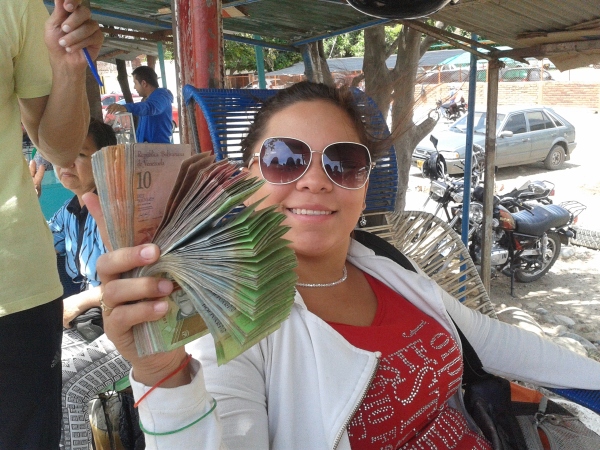
Angie: The Bolívar is her business…
In context...
In San Antonio del Táchira2 it is almost “Mission Impossible” to find businesses that use “points of sale” to pay with a credit or debit card. We could confirm during our stay in that city, as part of field work about Border Journalism, with students of Social Communication from the Bolivarian University of Venezuela.
It was difficult to find any restaurant with this method of payment and after a lot of searching we found that only the fast food places have “EFTPOS”. In the rest, all over the place you read: “There's no EFTPOS. Only cash”. The reason?: our notes of 100 and 50 Bolivars (Bs) are really coveted to be traded in an illegal manner and to obtain juicy profits. A practice that has been perfected, and that in the first instance was common among Colombian citizens (I haven't lost my capacity to be amazed by their creativity), but that now, lamentably, it has generalised itself among Venezuelans also, that is to say, everybody is in that game. The important thing is to make easy money, without working too much and to do so safely and quickly. The other thing is that the notes manage to pass to the other side and in great quantities...
The question is why the National Banking Association or the Central Bank of Venezuelan doesn't intervene? Each time that we had to pay in cash for some food, the owner of the business would be making calculations of the profits that they expected from it. With each Bs. 100 note that they saw their eyes sparkled, like the gold tooth of Pedro Navaja.3
In that border crossing the Venezuelan banknotes serve to: 1) be sold in currency exchange offices in Cúcuta. The profit in bolivars is fast and they deposit it directly in your bank account. If it's with Banesco even better; 2) be sold by “pirate” money changers to Colombians that need to buy subsidised Venezuelan products. They sell them cheaper than the “legal” currency exchange offices that by the way fix their rates according to the guide of the Dólar Today4 website; 3) be exchanged in Colombia for Colombian pesos that later re-enter Venezuela to buy bolivars.
I live off your bolívar…
The phrase makes me shudder. I asked her permission to take the photo and she posed smiling. And I have to ask her..
What does your business consist of?
– The business is that I sell bolivars. On very good days I can sell up to one thousand bolivars and with that I can myself up to seven thousand pesos. During the week the profit is very good and sometimes take away some 60 thousand or 70 thousand pesos in the week.
A what rate do you sell them?
- It depends on how it is below (in Cúcuta) and on how we receive it, and bit by bit the profit is left over. On the weekends and at the ends of the month the bolivar goes up more because few currency exchange offices open and then we earn a little bit more.
And that is legal? I say the Colombian police are right there. They don't put you in jail?
– Legal, it isn't, of course, but they leave us alone and we always give something to them...
If you take away 60 thousand pesos a week, then a month...?
– Like 500 thousand pesos...This is my job, I live from this.
How do the notes arrive to you?
(…) She holds back a sly smile and doesn't respond…
Then that [idea] that the bolivar isn't worth anything? For you, it's worth something, isn't it?
– I live off your bolivar…
The interview is suspended because a Colombian lady arrives on a motorbike to buy bolivars. She has a boy behind her on the back of the bike. She wears a helmet, but he doesn't. She gives me a dirty look when I take her photo while Angie sells her the notes.
What are you buying notes for?, I ask her
– The thing is that I am going to the hairdresser, it works out cheaper in San Antonio...
How much is it going to buy?
– I need 600 bolivars. Don't take photos of me.
And why don't you buy them in a money exchange offices?
– Ah the thing is that she is my friend…
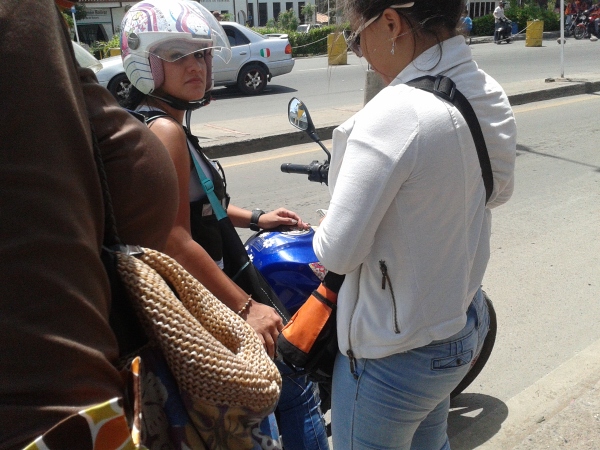
Don't take photos of me!
In two minutes, Angie earns herself 600 pesos. We can't keep talking because more customers arrived. Before that she told me that she studied Pharmaceutical Service and that selling bolivars not only pays for her studies, but that it helps her family.
The lines at the cash machines
The worst idea that occurred to the students, Ana Purroy and Héctor Serrano, was to take out cash from an automatic teller machine there in San Antonio of Táchira. They both located one from the Bank of Venezuela and they had to wait at least two hours in the line. From that experience Ana constructed the following account that closes (for now) the series of reports from the hottest border in Latin America:
“In plaza Bolívar de Cordero, in San Antonio del Táchira, you live daily a totally irregular situation due to long lines to get cash out of the automatic teller machines (ATMs). According to neighbours of the place, sometimes you can take up to six hours to make a transaction due to the tremendous demand for Venezuelan banknotes. We had to beg that they might let us take out some cash.
You deal with one of the modus operandi for the extraction of the Venezuelan currency to Colombia. Our currency is exchanged for pesos in Cúcuta and returns to San Antonio again to buy bolivars. The exchange is strange but is due to the fact that for every thousand pesos exchanged in Venezuela the percentage of profit is between 25 to 30%.
The practice in the ATMs is done in the following manner: from a personal account you can make up to three transactions and take out each time up to 600 Bs. Two of banks (Venezuela and Banesco) allow you to get out 20 thousand BS, but as it doesn't give it all at one time you have to put in your cards many times. One person goes to the ATM with more than one card from different banks and like that you can take out three times with each one. The other business is that there are people that offer to wait in the queue for you and they pay them 600 Bs per card, that is to say, if you have six cards from six different banks, they earn up to 3,600 Bs.5 There are people that live from that, from waiting in the line at ATMs in San Antonio del Táchira..
This was a practise that only Colombians used to carry out, but now Venezuelans have adopted it also and we wonder if the proper Venezuelan authorities are aware of this illegal procedure given that while we were in the line we noticed the presence of the Bolivarian National Guard (GNB) near the ATM, but they never intervened despite the fact that the irregularity was obvious.”
Angie is a young Colombian woman scarcely 26 years old. Every day she sets up her stall in a place called “La Parada”,1 Cúcuta, a few metres from the Simón Bolivar International Bridge and under the noses of Colombian customs.
We found her smiling despite the heat in the area. Of course, she fans herself with a wad of Venezuelan notes...
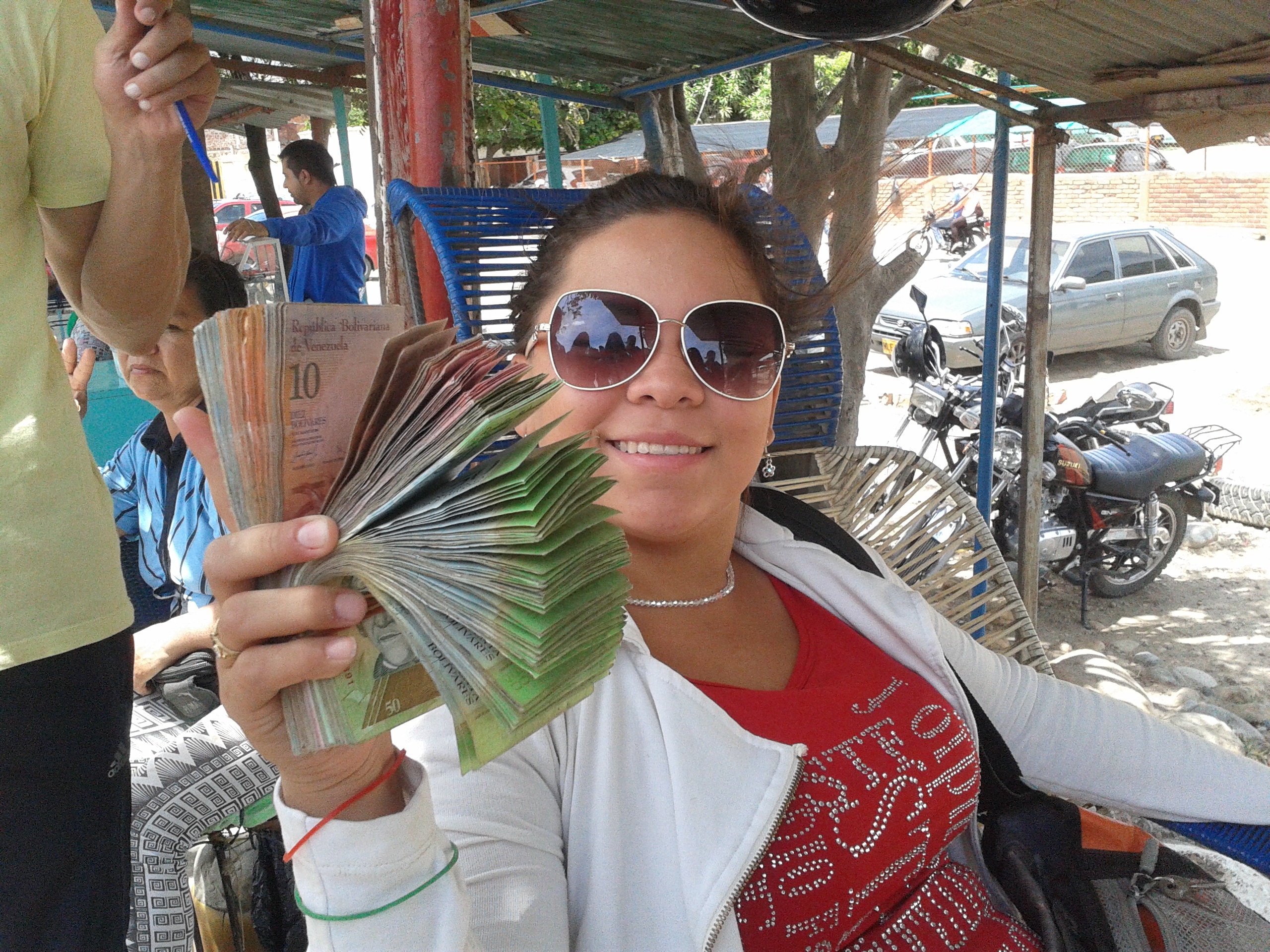
Angie: The Bolívar is her business…
In context...
In San Antonio del Táchira2 it is almost “Mission Impossible” to find businesses that use “points of sale” to pay with a credit or debit card. We could confirm during our stay in that city, as part of field work about Border Journalism, with students of Social Communication from the Bolivarian University of Venezuela.
It was difficult to find any restaurant with this method of payment and after a lot of searching we found that only the fast food places have “EFTPOS”. In the rest, all over the place you read: “There's no EFTPOS. Only cash”. The reason?: our notes of 100 and 50 Bolivars (Bs) are really coveted to be traded in an illegal manner and to obtain juicy profits. A practice that has been perfected, and that in the first instance was common among Colombian citizens (I haven't lost my capacity to be amazed by their creativity), but that now, lamentably, it has generalised itself among Venezuelans also, that is to say, everybody is in that game. The important thing is to make easy money, without working too much and to do so safely and quickly. The other thing is that the notes manage to pass to the other side and in great quantities...
The question is why the National Banking Association or the Central Bank of Venezuelan doesn't intervene? Each time that we had to pay in cash for some food, the owner of the business would be making calculations of the profits that they expected from it. With each Bs. 100 note that they saw their eyes sparkled, like the gold tooth of Pedro Navaja.3
In that border crossing the Venezuelan banknotes serve to: 1) be sold in currency exchange offices in Cúcuta. The profit in bolivars is fast and they deposit it directly in your bank account. If it's with Banesco even better; 2) be sold by “pirate” money changers to Colombians that need to buy subsidised Venezuelan products. They sell them cheaper than the “legal” currency exchange offices that by the way fix their rates according to the guide of the Dólar Today4 website; 3) be exchanged in Colombia for Colombian pesos that later re-enter Venezuela to buy bolivars.
I live off your bolívar…
The phrase makes me shudder. I asked her permission to take the photo and she posed smiling. And I have to ask her..
What does your business consist of?
– The business is that I sell bolivars. On very good days I can sell up to one thousand bolivars and with that I can myself up to seven thousand pesos. During the week the profit is very good and sometimes take away some 60 thousand or 70 thousand pesos in the week.
A what rate do you sell them?
- It depends on how it is below (in Cúcuta) and on how we receive it, and bit by bit the profit is left over. On the weekends and at the ends of the month the bolivar goes up more because few currency exchange offices open and then we earn a little bit more.
And that is legal? I say the Colombian police are right there. They don't put you in jail?
– Legal, it isn't, of course, but they leave us alone and we always give something to them...
If you take away 60 thousand pesos a week, then a month...?
– Like 500 thousand pesos...This is my job, I live from this.
How do the notes arrive to you?
(…) She holds back a sly smile and doesn't respond…
Then that [idea] that the bolivar isn't worth anything? For you, it's worth something, isn't it?
– I live off your bolivar…
The interview is suspended because a Colombian lady arrives on a motorbike to buy bolivars. She has a boy behind her on the back of the bike. She wears a helmet, but he doesn't. She gives me a dirty look when I take her photo while Angie sells her the notes.
What are you buying notes for?, I ask her
– The thing is that I am going to the hairdresser, it works out cheaper in San Antonio...
How much is it going to buy?
– I need 600 bolivars. Don't take photos of me.
And why don't you buy them in a money exchange offices?
– Ah the thing is that she is my friend…

Don't take photos of me!
In two minutes, Angie earns herself 600 pesos. We can't keep talking because more customers arrived. Before that she told me that she studied Pharmaceutical Service and that selling bolivars not only pays for her studies, but that it helps her family.
The lines at the cash machines
The worst idea that occurred to the students, Ana Purroy and Héctor Serrano, was to take out cash from an automatic teller machine there in San Antonio of Táchira. They both located one from the Bank of Venezuela and they had to wait at least two hours in the line. From that experience Ana constructed the following account that closes (for now) the series of reports from the hottest border in Latin America:
“In plaza Bolívar de Cordero, in San Antonio del Táchira, you live daily a totally irregular situation due to long lines to get cash out of the automatic teller machines (ATMs). According to neighbours of the place, sometimes you can take up to six hours to make a transaction due to the tremendous demand for Venezuelan banknotes. We had to beg that they might let us take out some cash.
You deal with one of the modus operandi for the extraction of the Venezuelan currency to Colombia. Our currency is exchanged for pesos in Cúcuta and returns to San Antonio again to buy bolivars. The exchange is strange but is due to the fact that for every thousand pesos exchanged in Venezuela the percentage of profit is between 25 to 30%.
The practice in the ATMs is done in the following manner: from a personal account you can make up to three transactions and take out each time up to 600 Bs. Two of banks (Venezuela and Banesco) allow you to get out 20 thousand BS, but as it doesn't give it all at one time you have to put in your cards many times. One person goes to the ATM with more than one card from different banks and like that you can take out three times with each one. The other business is that there are people that offer to wait in the queue for you and they pay them 600 Bs per card, that is to say, if you have six cards from six different banks, they earn up to 3,600 Bs.5 There are people that live from that, from waiting in the line at ATMs in San Antonio del Táchira..
This was a practise that only Colombians used to carry out, but now Venezuelans have adopted it also and we wonder if the proper Venezuelan authorities are aware of this illegal procedure given that while we were in the line we noticed the presence of the Bolivarian National Guard (GNB) near the ATM, but they never intervened despite the fact that the irregularity was obvious.”
1“The
Stop”
2 San Antonio del Táchira is a Venezuela city on the border with Colombia. A highway from San Cristóbal, the capital of state of Táchira, to Cúcuta, Colombia passes through the city and makes it an important transit point between the two countries.
Monday, 10 August 2015
The historic embezzlement of the Mendoza family from Venezuela (translation)
Originally published at:
http://misionverdad.com/la-guerra-en-venezuela/el-desfalco-historico-de-la-familia-mendoza-a-venezuela
August 4, 2015, 12:51 pm
The criminal record of a family that
defrauded the nation
The historic embezzlement of the Mendoza family from Venezuela
The owner of the Polar companies, besides being a wealthy man
with 2.7 billion dollars in his personal portfolio, wants to give
economics and politics classes to the Bolivarian1
government. He tries to hide his family's past, that took advantage
of the economic resources of the country during almost all of the
20th century to fill its pockets and take control of
industries. But the truth always comes to light. Below, the criminal
record of the Mendoza family.
The Mendoza coat of arms was cast in
Basque lands. The Creole descendants of the noble house arrived in
Venezuela territory settling between the uplands and the valleys of
Trujillo.
Before Cristóbal Mendoza could impose his figure as the first republican president of Venezuela, installed in the inaugural leadership of the triumvirate that declared independence in 1810 with a flourish of the powerful creole elite, there were four generations previous to those installed in the the Valley of Caracas. The historic reliance of the Mendoza family on state institutions has reserved its private interests, without doubt, although with a low profile.
Until Eugenio Mendoza arrived, who during the government of Medina Angarita was named minister of Development, a position that he would return to hold in the Military Junta of 1958. This businessman said at one point that his emporium that he started without any capital, but among the papers you find his signature as “industrial partner” in Moisés Miranda & cía, whose shares he bought entirely in 1932 to convert it into Materiales Mendoza, S.A. The buying, selling and importing of construction materials was the first business. From there on he would climb the ladder until he obtained government posts to inject bolivars 2into his personal portfolio.
His brother, Eduardo Mendoza Goiticoa, during the so-called Adeco3 triennium (1945 – 1948), was minister of Agriculture and Breeding, as well as, the Venezuela Institute for Immigration, assigned to the ministry that he headed, to bring European refugees and displaced people to put them to work: a cheap workforce wasn't looking for land in the countryside. It is calculated that 20,000 immigrants worked in the rice fields that they inaugurated due to the foundation of the Turén Agricultural Unit, in the state of Portuguesa, that devastated the small farmer towns of the zone in order to initiate the capitalist mechanisation of farmland which was so much the trend for the time.
It is worth highlighting his marriage to Hilda Coburn Velutini, this final last name associated with the family involved in the construction business, which made them rich, and later with banking speculation. His daughter, Antonieta Mendoza de López, is the mother of today's (non-)political prisoner Leopoldo López.
Together, Eduardo and Eugenio Mendoza founded Protinal, a company that produces food extracts for animals. In this way, the Grupo Empresas Mendoza, whose capital came from the Venezuelan state, started like good leeches on the Venezuelan economy.
Without scruples to negotiate
Marcos Pérez Jiménez, whose dictatorship was characterised economically by attracting North American capital in favour of the small military caste that sustained itself in state power, confessed to Blanco Muñoz the parasitic attitude of this faction of the Masters of the Valley:
"Eugenio Mendoza presented himself before me with a plan to develop the Matanzas Iron and Steel Plant, for 150 thousand tonnes. He asked in exchange that I might give him at once the Cerro of Parima, so that they might establish economic restrictions for the importation of steel. And practically he arrived at proposing that the government might give it to him to exercise it. The government had a more hierarchically-organised plan, that it is set down there and that is captured in the Matanzas Iron and Steel Plant. Then how were we going to give this to Eugenio Mendoza, with all the state property questions, for his benefit, in order that he might establish a minuscule plant that didn't satisfy the needs of the country? Here we were talking about three plants. Eugenio Mendoza couldn't carry that out and because of that the Venezuelan state dedicated to do it itself. If a company that might have been Eugenio Mendoza´s or another, had presented us with a plan of the magnitude that we had told them: go ahead. But what did Eugenio Mendoza do in the case of General Medina? Well, obtaining a licence to import smooth zinc sheets, and then put them in a small machine that corrugated them and for that the Venezuelan public had to pay extremely elevated prices. For the aluminium sheets that corrugated Eugenio Mendoza. And then he pocketed an extraordinary profit. And the Venezuelan customer, the consumer had to pay extremely high prices”.
The Mendozas didn't distinguish the actors of the negotiations, as long as their own bank account grew with less than the minimum of effort. Puntofijismo4 was the remaining piece to incorporate themselves fully in the key positions of the Venezuelan economy, due to the fact that Cisneros made itself into the lobby to bring themselves together with the US oligarchy of the Mills, creators of the biggest mill company in the world: Pillsbury Mills. In Venezuela it had its enclave with the names of Monaca (Robin Hood, Lassie, Juana, Mónica) and Molinos Caracas Maracaibo, S.A. (Milani, Suprema).
Thanks to this contact, the Mendoza part that entrusted itself with agribusiness and agroconfeti5 got to import the mills and today grind wheat and corn for the fabrication and distribution of Polar products and the other tasty snacks that pertain to the transnational network of Pepsico (Doritos, Ruffles, Gatorade, Frito Lays, etc.).
The migration to the financial sector
The new models of criminal accumulation of capital encoded themselves through the speculation on oil income through finance, the buying and selling of shares and bonds and banking. This migration made the traditional Masters of the Valley (Mendoza, Vollmer, Zuloaga) sometimes join together with the friends of Pedro Tinoco in the middle of the decade of 1970.
The Mendozas possessed half of Banco Provincial and important shares in Banco de Venezuela. They also took control of Banco Venezolano de Crédito and Banco La Guaira Internacional.
How did they manage to have so many shares and banks in their possession? Placing men of confidence in the puntofijist governments and in the business institutions.
A brief compendium of those connected to the Mendozas: Caldera I
- Lorenzo Fernández, COPEI party6 and minister of Interior Relations during the first government of Rafael Caldera, he was also the president of Productos EFE (today of Polar). The uncle of the brothers, Armando y Alberto Espinoza Fernández, both part of the Coordination Council of Empresas Mendoza. Alberto Espinoza, besides, was the first vice-president of C.A. Venezolana de Cementos, one of the most lucrative businesses of Eugenio Mendoza.
- Haydeé Castillo was a minister of Development and the Tax Office and director of the Department of Economic Investigations of the Grupo Empresas Mendoza.
- Andrés Germán Otero was designated the director of the Central Bank of Venezuela (BCV). In 1974 served as the second vice-president of C.A. Venezolana de Cementos.
- Alfredo Lafee, president of BCV from 1971 until 1974. In 1978, active shareholder of Sherwin Williams, besides serving as the principal director of Cavaín Sociedad Financiera and president of Banco La Guaira Internacional.
- President of Compañía Venezolana de Guayana (CVG) between
1970 and 1973, the General (R) Rafael Alfonzo Ravard was a wealthy
investor in the iron and steel plant, Sivensa, on whose board of
directors generations of Mendozas have warmed seats. But the most
important thing in Alfonzo Ravard's record, on top of legislating in
favour of the grupo Alfonzo Rivas y compañía, is that he was the
first president of Petróleos de Venezuela, that was born with the
supposed nationalisation of oil. And here commences the list of
Carlos Andrés Pérez (CAP) I.
A brief compendium of those connected to the Mendozas: CAP I
- Pedro Tinoco, the supreme operator of the Twelve Apostles of CAP, he was the acting director of Banco La Guaira Internacional.
- Gustavo Pinto Cohen, besides minister of Agriculture and Breeding, in 1978 appeared as the director of BCV. He was the acting director of Cavendes, a financial society in which the families Boulton, Blohm, Cervini, and of course Mendoza participate, amongst others.
- Carlos Romero Zuloaga, director of Meneven, even before its nationalisation, when it was called Mene Grande Oil Company. In 1978 he appeared registered as the principal director of Banco La Guaira Internacional and as president of Industria Eternit.
- César Mendoza passed from being the acting director of Siderúrgica del Orinoco (Sidor) to the de-facto director in 1975. President de Venalum (today Corporación Nacional de Aluminio) and of Adriática de Seguros, has capital invested in the private steel and iron industry.
- Luis Ignacio Mendoza was acting director of Aluminios del
Caroní in 1975, a mixed enterprise with CVG, and with capital
invested by the Reynold Metal Company. In 1978 he passed to be
principal director of Siderúrgica Venezuela and of the previously
mentioned Sivensa. He also served as director of Calanese de
Venezuela and president of the company Cantonez de Venezuela.
- Cementos Guayana, company that had as president Eduardo Pantin in 1975, who by 1978 was the acting director of C.A. Venezolana de Cementos. Another person that was on the board of directors of Cementos Guayana was Gerardo Sansas, who in 1978 occupied the post of president of C.A. Venezolana de Cementos. Both loyal representatives of the Mendoza group.
- Fior de Venezuela had as president José Antonio Mayobre
between 1975 and 1978, before having occupied the central office of
the ministry of Tax during Betancourt government. Besides Mayobre
appeared on the board of directors of Avensa and as a shareholder of
Banco de Venezuela in 1978.
The foolish rich and the generation of replacement
Juan Carlos Zapata has qualified as “the foolish rich” those businesspeople that didn't know how to avoid the crisis that they themselves had created through the sacking of the state and financial speculation, and that by themselves saw all their monopolies turned to ashes in the midst of the hurricane. "Eugenio Antonio (Mendoza) hadn't learned the lesson from his father”, as Zapata says, of involving himself in politics during the the decades of 1980s and the start of the 1990s before the banking crisis in order to strengthen the industries and financial institutions that had passed on to the stupid son of the Mendozas.The Mendoza family lost all the emporium that had developed in some decades of usufruct and speculation. Only once branch of the group (the Mendoza Fleury-Quintero-Pocaterra-Giménez) managed to escape from the debacle due the strengthening of the production and distribution branches that it possessed due to the embezzlement by the part of Mendoza Goiticoa lineage, besides always going around with its low business profile, media silence and little public attention.
In this way, Empresas Polar managed to function as the only Masters of the Valley that expanded with its litres of beer and tonnes of agroconfeti sold as national basic foods. By 1995, Grupo Polar had in its possession 2 billion dollars, when Oswaldo Cisneros and José Álvarez Stelling scarcely have 500 million dollars each in their bank accounts. The bear didn't sleep in its cave, it made use of the fall of the rest of the economic groups and erected itself as a lead actor in the development of plundered Venezuela.
Lorenzo Mendoza, today the leader of Polar, hasn't had to work but investing together with his financial friends what his daddy left him, Mendoza Quintero, well-loaded with money. It is this family that tries to return to power in order to run away with all the public resources possible in benefit of its private pocket. The role of torture for dollars while the economic war takes place in factories and distribution networks inside on behalf of Polar is the same role that its ancestors fulfilled from the comfortable office of some ministry.
Translator's notes:
1 current Venezuelan government whose policies are based on ideas of Simón Bolivar, 19th century Venezuelan general and liberator who led the struggle for independence throughout much of Hispanic America, and extolled by Hugo Chavez as: anti-imperialism; participative democracy; economic self-sufficiency; instilling in people a national ethic of patriotic service; quitable distribution natural resources; eliminating corruption
2Venezuelan
currency
3government by the Acción Democrática party
4 Pact of Punto Fijo was agreed between representatives of Venezuela's three main political parties in 1958: Acción Democrática, COPEI and Unión Republicana Democrática. The pact bound the parties to limit Venezuela’s political system to an exclusive competition between two parties and the distribution of power between the two main political parties.
Subscribe to:
Posts (Atom)